
Carteret County Release Meanings
A Carteret County release closes one custody episode. It does not always mean the person is free from every form of custody or control. The Carteret County Detention Center may release someone to the community after bond, a court order, dismissal, or completion of a local sentence. It may instead transfer that person to NCDAC, another jail, federal authority, or another lawful custodian. Carteret Correctional Center has its own state-prison release path. Its residents may leave on post-release supervision, eligible parole, sentence expiration, a court order, or a transfer.
The agency that held the person creates the most useful exit record. Detention staff execute the movement and record when it occurred. A court judgment may explain the authority for release, yet it does not show the exact moment staff completed it. Likewise, a missing name on a current roster is only a clue. It can reflect a transfer, a delay, an alias, a corrected entry, or a record outside the portal’s scope. Carteret County released inmates are best confirmed with a released classification or dated release entry and a second source when timing or destination matters.
- Discharge
- The end of a custody or supervision episode shown by the responsible agency.
- Time served
- A sentence has been satisfied after lawful credit and time are applied.
- Post-release supervision
- Community supervision that follows an eligible North Carolina prison term.
- Detainer
- A request from another authority that can lead to a custody handoff.
Carteret County Release Routes
The release label controls the next search. Bond permits pretrial liberty when stated conditions are met, but the criminal case continues. A dismissal or other court order may end the legal basis for one matter, though another hold can remain. Time served refers to a completed local sentence after credit is applied. Probation is imposed by a court and occurs in the community. Parole applies mainly to older or specially eligible state sentences, while post-release supervision follows many modern felony prison terms.
| Recorded route | What it means | Best next check |
|---|---|---|
| Bond or pretrial order | The jail processed conditional release to the community. | Carteret release entry and court case |
| Time served | The recorded local term and applicable credit were satisfied. | Jail calculation and judgment |
| Probation | A court ordered community supervision. | Court judgment and Community Supervision |
| PRS or parole | A state prisoner left prison under Commission conditions. | NCDAC status and supervising office |
| Transfer or detainer | The person left one building but remained in custody. | Named receiving agency |
| Sentence expiration | The custodial term reached its lawful end. | Completed release record |
Never turn a movement label into a broader claim. “Released from Carteret County Detention Center” can describe a transfer to a state prison. “Released from NCDAC” can also mean a handoff under a pending warrant or detainer. The destination field, current agency status, and court file show whether the person entered the community or remained confined elsewhere.
Carteret County Release Record Fields
A focused Carteret County release record request should name the exact fields needed. The county’s public released-booking detail is useful for discovery, but the inspected record did not display the precise release time, release reason, or destination. Those are the facts most likely to resolve whether an exit was a bond release, a sentence completion, or a transfer. Use the booked name, date range, and booking or inmate number when known.
| Field or document | What it establishes |
|---|---|
| Booked name and aliases | Connects the request to the correct identity record. |
| Booking or inmate number | Identifies one Carteret jail episode. |
| Admission date and time | Marks the start of that detention episode. |
| Release date and time | Records when the custodian completed the exit. |
| Release code or reason | Distinguishes bond, court order, sentence served, transfer, or another category. |
| Destination or receiving agency | Separates community release from continued custody. |
| Court or process number | Links the detention event to the legal file. |
| Booking photograph | Documents intake identity, not guilt or present custody. |
The release summary and court judgment answer different questions. The Sheriff’s record shows execution. The clerk’s file shows the legal order, disposition, sentence, and later court activity. Request both when the authority and exact exit time are important. A charge row, bond amount, or upcoming court date on the booking page does not prove why the person left.
Request Carteret County Release Records
Begin with the Carteret County Detention Center for a county jail release. Its portal-help and detention number is 252-504-4832. The detention-specific address is 306 Craven Street, Beaufort, NC 28516. The broader Sheriff contact is 304 Craven Street and 252-728-8400. No official page reviewed supplied a dedicated jail-record web form, booking-photo fee, records-unit hours, or fixed response deadline. Call first to confirm the current submission route, then seek an existing record rather than asking staff to create a new report.
- Give the full booked name, approximate admission date, and booking number if known.
- Ask for the admission and release date and time, release code, and receiving agency or destination.
- Request the court or process number and adult booking photograph when those existing items are needed.
- State that electronic copies are preferred. Ask for the public remainder and legal basis if a field is withheld.
- Compare the response with the matching Carteret court file or receiving-agency record.
306 Craven Street
Beaufort, NC 28516
252-504-4832
Fax: 252-504-4801
North Carolina law allows inspection and copies at reasonable times. It does not require a requester to state a purpose. Ordinary copy charges are limited to actual reproduction cost unless another law applies, while extensive staff or technology use can support a reasonable special-service charge. The research found no Carteret-specific posted amount, so do not assume a fee. State retention guidance lists active and inactive inmate incarceration records, including entry and release summaries, for destruction three years after release or transfer. That rule does not promise three years of web access.
Carteret County Release Record Laws
North Carolina General Statutes Chapter 132 broadly defines public records and covers photographs and electronic records made or received in public business. G.S. 132-6 calls for prompt access to records subject to lawful limits. G.S. 132-6.2 addresses format, actual-cost copies, special-service charges, and the rule that an agency need not create a record that does not exist. G.S. 162-22 separately requires the sheriff to keep jail records.
Public status is field-specific. Juvenile information, sealed or expunged material, medical details, security-sensitive content, confidential identifiers, and some investigative information can be withheld or handled under other law. NCDAC treats most internal prison files and community-supervision files as confidential, while basic conviction, time served, sentence length, admission, and release dates remain public. A narrow request for a release summary is more useful than a demand for every item in an inmate file.
An expunction can remove, seal, or destroy qualifying records after a court order. A missing online result may reflect that process, not proof that no custody event occurred.
The North Carolina Judicial Branch expunction resource explains the court process and forms. Eligibility varies, and completion of confinement or supervision may matter. Keep a copy of an entered order because a clerk may be unable to reproduce it after destruction.
Search Carteret County Released Inmates
Use a custody-specific sequence. Start with the Sheriff’s current portal only to test whether the person is still displayed at the county jail. Then move to the county-hosted released mode. A current hit is evidence of displayed custody. A miss is not proof of release. Presence in the released mode is stronger because the Carteret system has classified that booking as released, but its public detail still may not disclose whether the person entered the community or transferred.
- Search the exact name and reasonable variants in the current Carteret portal.
- Search the separate released mode by name or a user-selected day window.
- Call the detention line for the physical release time, type, and destination when timing matters.
- Check NC SAVAN for a reported custody event and verify the source agency.
- Use NCDAC if state intake, state prison, probation, parole, or PRS is plausible.
- Read the Carteret court case for the order, bond action, judgment, and disposition.
- Use BOP or ICE only when the facts point to the matching federal system.
A released person normally leaves the live jail roster. A roster disappearance alone cannot distinguish community release, transfer, data lag, or a corrected record.
For the official interface, the Carteret all-released results show how the county separates released bookings from the current roster.
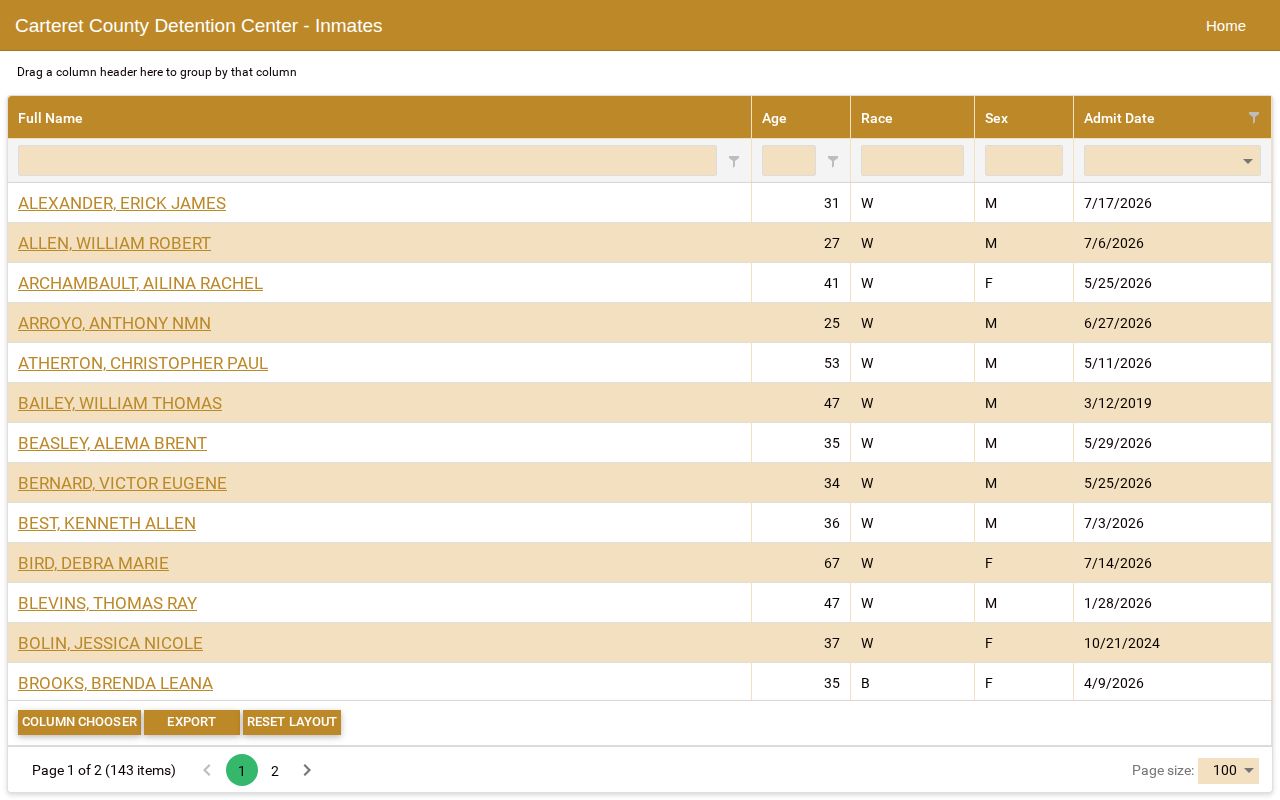
The screen is a discovery tool. Confirm exact release facts through the underlying Sheriff record, especially when the result could represent a transfer.
Carteret County State Release Search
The NCDAC Offender Public Information Search covers state prisoners, people under state community supervision, and inactive state records. It does not contain every Carteret jail booking. Search by offender number when possible. Otherwise, combine the name with birth date or age and descriptive fields, then review the whole chronology. A past release row can exist beside a later admission.
| Search field | Best use | Important limit |
|---|---|---|
| Offender number | Most precise state identifier | Not a Carteret booking number |
| Status: All | Checks active and inactive records | Requires reading current status |
| Active Inmate | Shows present NCDAC prison status | Not a released result |
| Active Probationer/Parolee | Shows physical release with state supervision | Does not mean supervision ended |
| Inactive | Finds a closed state custody or supervision history | Later systems may still hold the person |
| Name and birth range | Helps separate similar names | Names alone can collide |
NCDAC also provides a dedicated Inmate Release Search by release county and period or by name. Carteret is county code 16. Its result fields include offender number, name, release date, primary offense, and release type. “Release county” is a state-prison reporting field, not the Sheriff’s booking list.
The official search image below comes from the state offender interface and helps identify the available status fields.
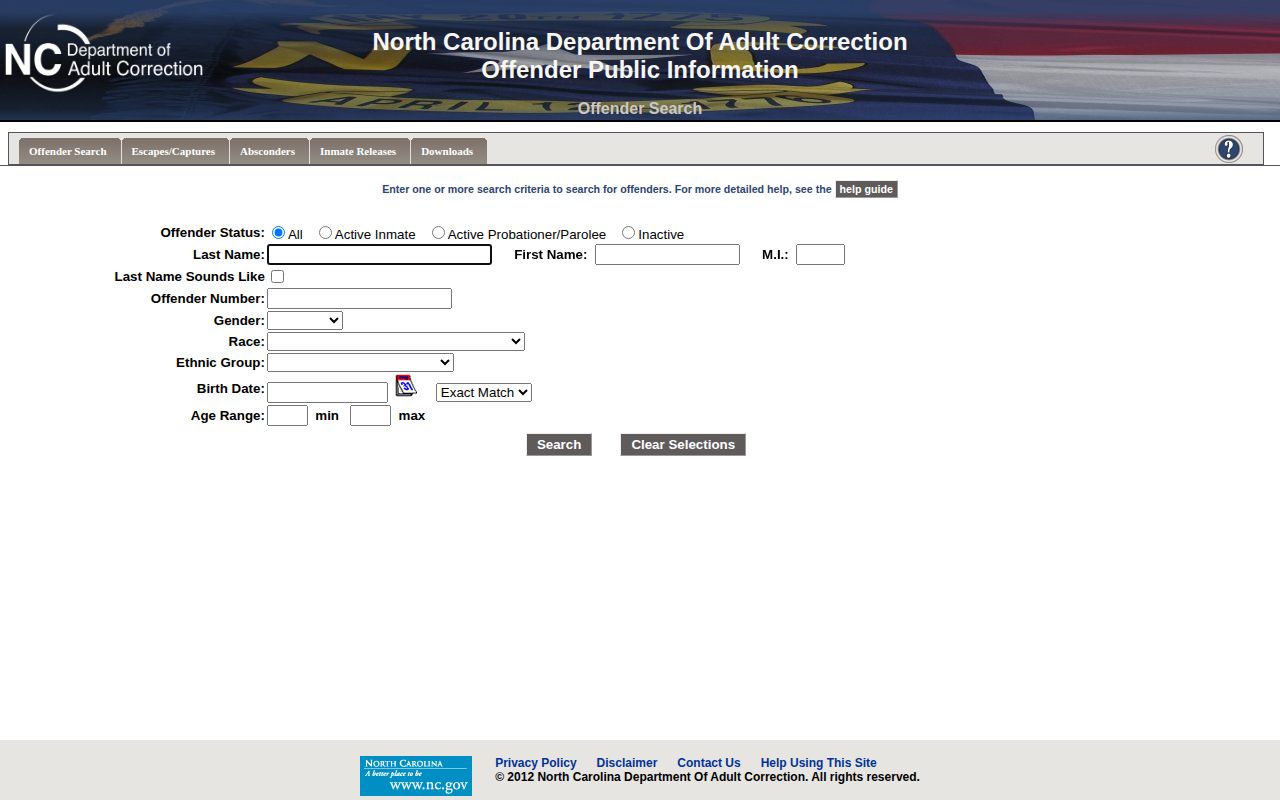
Read the current status before relying on any release date. A projected date is not proof that the release occurred.
Carteret County Recent Release Mode
Carteret’s strongest released-first source is easy to miss. The Sheriff’s wrapper calls its main product “current inmate information,” yet the county-hosted application has a separate released search. It accepts a name, charge description, or releases over a number of days. Entering 1 produces the last-day query. Entering 3 produces the three-day query. These are two uses of one form, not two fixed branded feeds.
The all-released grid visibly includes a name, age, race, sex, and admit date. Its responsive fields may also show the primary charge and court type. An opened released detail can retain a mugshot, identity data, admit date and time, charges, offense date, court type and date, bond information, and arrest agency. The inspected detail did not show the exact release date, time, reason, or destination. The portal also publishes no update cadence or online retention promise.
Use the recent mode for “who left recently” and use a name search for one known person. Enter one day for the same-day view, or three days for a wider check. Record when the search was run. Then call or request the release entry if a delay, transfer, or exact time could change the conclusion.
Carteret County Reentry Releases
Carteret Correctional Center gives the county two nearby but separate release systems. NCDAC identifies the Newport institution as a male minimum-custody prison with a 300-person published capacity and a designated reentry role. People nearing the end of state custody may take part in work release. These are state-prison records. They do not belong in the Sheriff’s Beaufort released-booking view.
After a prison exit, NCDAC may show the person as an Active Probationer/Parolee if community supervision continues. PRS is the usual modern structured-sentencing layer for eligible felony cases. Parole applies chiefly to older or specially eligible sentences. An inactive state record generally means no current NCDAC imprisonment or supervision, but the full chronology still matters. Pending charges, warrants, and detainers can turn a scheduled exit into a handoff.
The official Carteret Correctional Center profile documents its state-prison and reentry role.
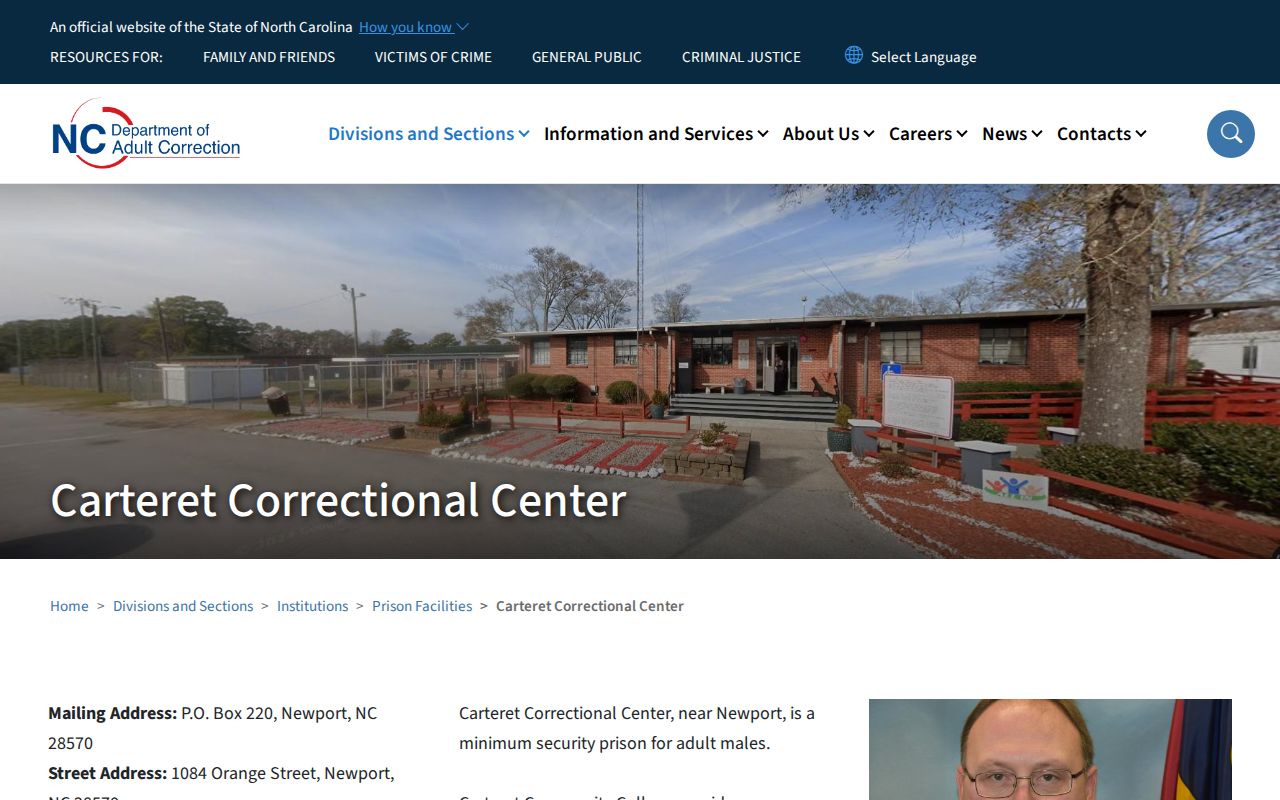
That state profile should be paired with Offender Public Information and Community Supervision records when confirming where a released resident went.
Carteret County Post-Release Property
Carteret has an unusual after-release mail path. Personal jail mail is scanned through Pay Tel. The Sheriff states that a former inmate may request digital copies after release by email. The request must include Carteret County Detention Center facility ID 5026, the person’s full name, inmate ID, and email address. This procedure covers scanned correspondence. It does not establish a general rule for physical property, gate money, identification, or pickup times.
The Sheriff’s scanned-mail-after-release instructions show the local process.
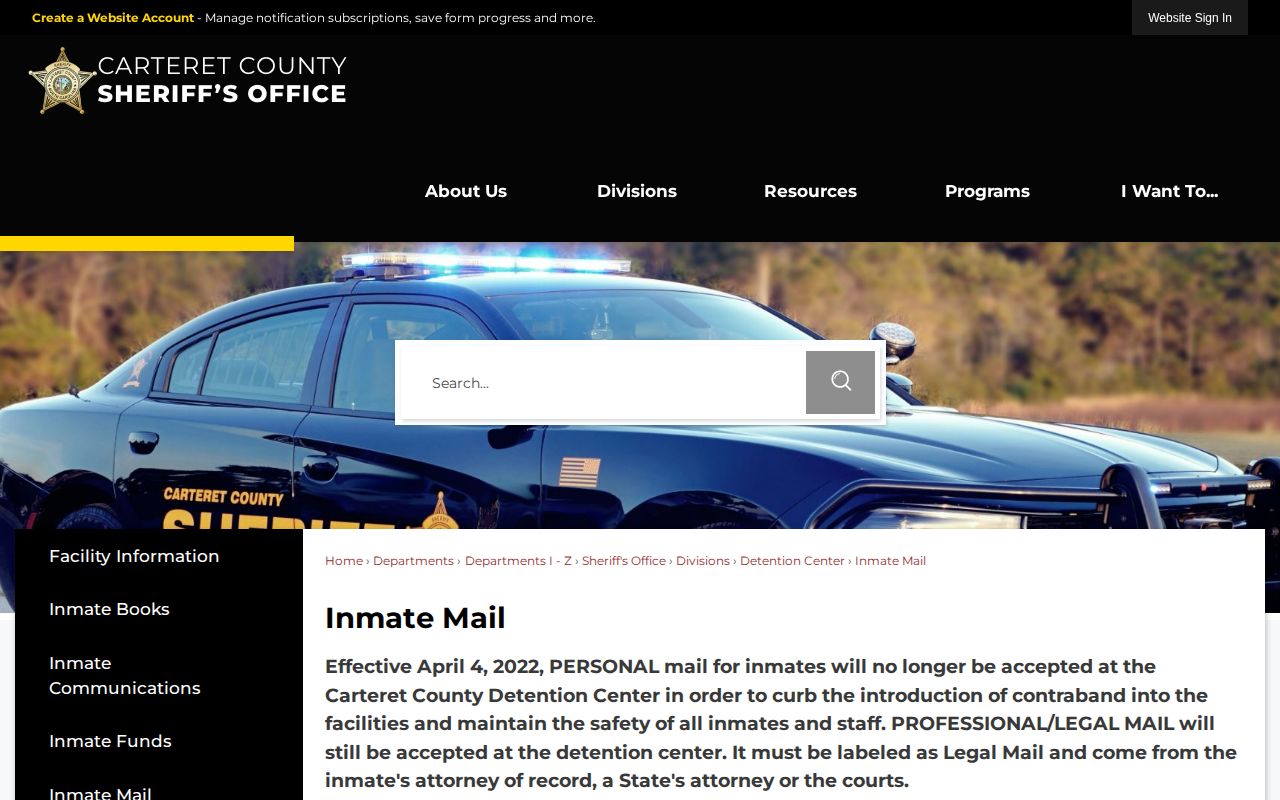
The identifiers direct the request to the correct detention account. They should not be confused with the separate steps for a release summary.
NCDAC follows a different state-prison procedure. Its release policy calls for staff to verify return of personal property, supply a transition-document envelope that may contain identification papers, and issue a paper prison-release photo ID. Those steps apply to state prison releases such as Carteret Correctional Center. No Carteret source supplied a comparable county-jail property procedure, so the two systems must remain separate.
Carteret County Release Supervision
Probation, parole, and post-release supervision are different legal statuses. A Carteret court imposes probation. The Post-Release Supervision and Parole Commission sets PRS conditions and decides the narrower set of parole matters allowed by law. NCDAC’s Division of Community Supervision handles field supervision. A person can be physically out of jail or prison while still shown as an Active Probationer/Parolee.
Verify supervision by searching NCDAC with status All, matching the offender number and identity, and reading the current status before older sentence entries. Carteret is served through Community Supervision Judicial District 3. The official district office is at 1904D South Glenburnie Road, New Bern, NC 28562, with phone 252-514-4822. Older official material lists Carteret offices in Beaufort and Morehead City, so confirm the present reporting site rather than publishing an old assignment as current.
An absconder entry means the agency alleges that a person is avoiding supervision. It does not prove a new arrest, return to prison, or completion of the release term. Check the current NCDAC record and supervising office. Conditions, reporting details, and termination are not fully exposed in the public offender display.
Carteret County Release Notifications
NC SAVAN, delivered through VINELink and the state hotline, is electronically linked with North Carolina jails, prisons, probation, and parole systems. Search for one person, match the source agency and identifiers, and treat a reported custody event as corroboration. A transfer requires registration with the receiving agency. SAVAN excludes people who never reach jail booking after a magistrate bond-out, police holds, juveniles, and mental-health facilities.
Notifications may cover projected release, release with or without supervision, transfer, escape, capture, and other supported changes. The supplying jail or NCDAC remains the final source when physical release is disputed. A notification cannot be stretched beyond its source agency. NC SAVAN is not a BOP or ICE locator.
Use the BOP locator for a sentenced federal prisoner. Use ICE’s locator for current immigration detention and the limited recent-release period described by ICE. USMS has no public historical released-person name search. These systems can follow a Carteret case even though no BOP institution or ICE-owned detention center was found within the county.
Carteret County Release Court Trail
Carteret released booking details preserve court type, court date, bond, and bond-type fields. That makes the court case the durable follow-up after a booking leaves the active jail roster. Bond data is not proof that bond caused the release. An interface court date is not a substitute for the court docket. Match the county and case number, then read the disposition, judgment, bond activity, confinement credit, and later orders.
The North Carolina court Portal provides anonymous public Smart Search for Carteret cases. Public terminals and paper files are also available through the clerk. Carteret County Courthouse is at 300 Courthouse Square in Beaufort. Its published main number is 252-504-4400, with weekday hours of 8:30 a.m. to 5:00 p.m. Verify the hours before travel.
The official Carteret County Courthouse page supplies the clerk’s contact and access information.
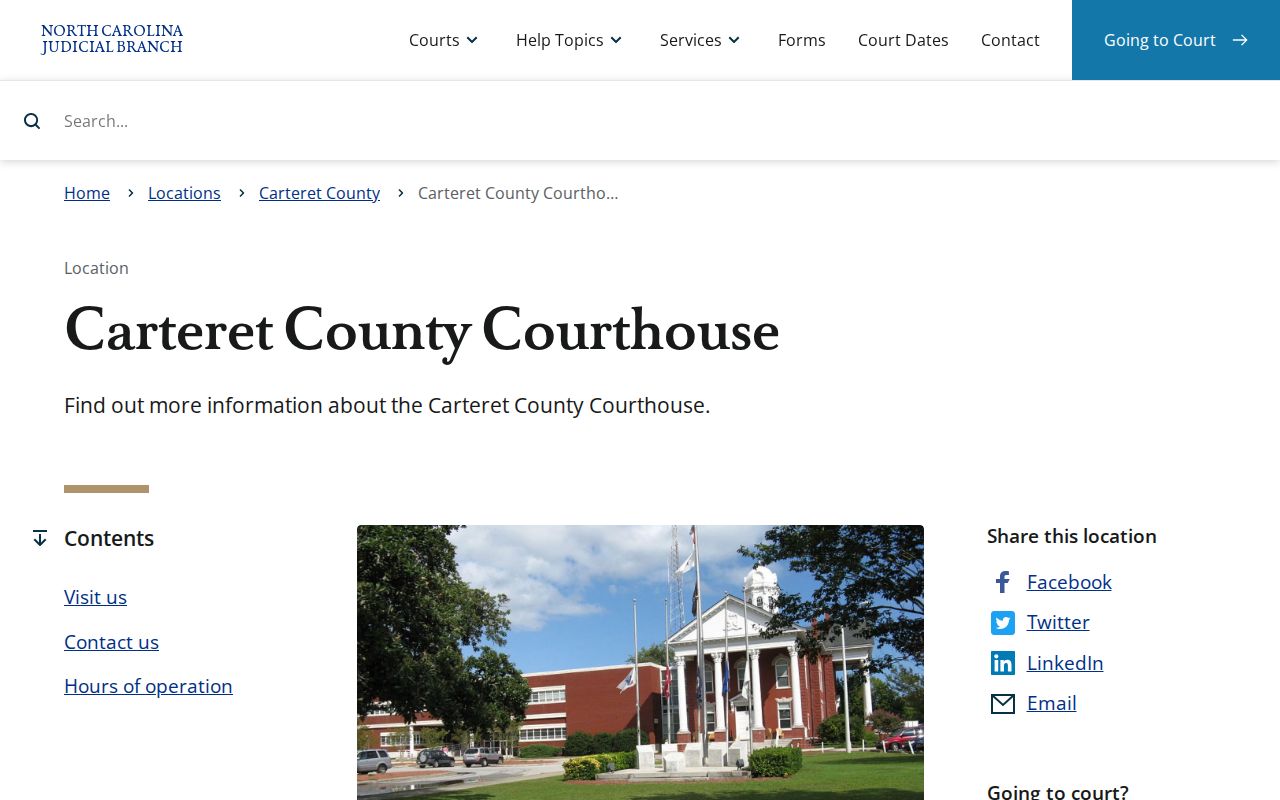
A clerk’s judgment explains legal authority. The Sheriff’s timestamp still supplies the best evidence of when jail staff completed the physical exit.
Carteret County ICE Release Transfers
An immigration detainer can change the meaning of a Carteret jail release. ICE describes a detainer as a request for another agency to hold a person for a limited period beyond the point that agency would otherwise release them, allowing a custody handoff. A Carteret entry that records release to ICE is therefore a transfer, not a community release. The receiving agency must be checked next.
ICE says its Online Detainee Locator covers current detainees and, in its attorney guidance, releases within roughly 60 days. Search by A-number and country of birth or by exact name, country of birth, and optional date of birth. An older absence is inconclusive because the tool is not a full historical archive. No official source established a Carteret County ICE detention contract, so no such local relationship should be inferred.
For a federal prison sentence, use the BOP Inmate Locator instead. A BOP result may show a past release date or “Not in BOP Custody,” but that only addresses BOP custody. It does not rule out another jail, immigration custody, or federal supervision. USMS manages many federal pretrial movements but does not offer a public historical released-person name search.
Carteret County Parole Release Reports
North Carolina does not publish a future calendar of named inmates’ individual parole hearings like some states. The Post-Release Supervision and Parole Commission instead publishes monthly discretionary-parole decision reports. The series began in September 2024. At research time it listed the months of 2025 and January through June 2026. This is a results cadence, not a promise of a public hearing date or time.
The Commission’s discretionary parole reports define outcomes such as Incomplete Decision, Suspend Decision, Regular Parole, Community Service Parole, Early Medical Release, and 90-Day Mandatory Parole. Modern discretionary parole has a limited scope because Structured Sentencing changed ordinary parole for offenses committed on or after October 1, 1994.
A report result is not the whole supervision record. Underlying Commission material is generally confidential, and a monthly authorized disclosure does not open the complete case file. Verify current community status in NCDAC Offender Public Information and route reporting or conditions questions to the correct Community Supervision office.
Carteret County Release Status Checks
The final check is always tied to the custodian. Carteret County Detention Center is the county’s only jail and holds pretrial detainees and qualifying local-sentence inmates. Carteret Correctional Center is a separate NCDAC state prison. Federal and immigration cases move through still other systems. A search should name the facility before drawing any conclusion from a result.
| Person or event | Correct first system | What to verify |
|---|---|---|
| Current Carteret jail custody | Sheriff current portal | Displayed current booking and facility |
| Recent Carteret jail exit | Released mode and detention record | Time, reason, and destination |
| Carteret state-prison release | NCDAC offender and release searches | Current status, date, type, and supervision |
| Carteret court disposition | NC court Portal or clerk | Order, judgment, bond action, and case status |
| Reported custody alert | NC SAVAN or VINELink | Source agency and whether the event was a transfer |
| Federal prison release | BOP locator | BOP date and whether another system follows |
| ICE custody or recent release | ICE locator and agency line | Current system scope and date checked |
What if every search returns no result? Check spelling, aliases, date ranges, source agency, and whether the person was ever booked into that system. SAVAN excludes some people who never reach a jail booking. A record may also be delayed, transferred, sealed, expunged, or outside the online date range. File a narrow request with the last known custodian when the public interfaces do not resolve the event.
Carteret County Release Facilities
Carteret County Detention Center is the Sheriff-operated county jail in Beaufort. Its released mode confirms that the local system moved a booking into the released category. The detention record supplies the exact time, type, and destination. Court records, SAVAN, NCDAC, or another receiving agency may provide the next confirmation.
Carteret Correctional Center is the NCDAC state prison in Newport. Releases from that facility appear in the state offender and inmate release searches. A person may leave the prison and remain under PRS or parole. The state record, not the Sheriff’s released-booking page, controls that release path.
Carteret County release questions usually turn on one difference: leaving a roster is not the same as leaving custody. A released classification, exact agency record, court authority, and receiving-agency check provide a much firmer answer.