Carteret Projected Versus Actual Release
A projected release date, or PRD, is a calculated future point. NCDAC uses that exact term and uses “max out” when discussing sentence expiration in the applicable setting. The date reflects the sentence and credits known when the calculation is viewed. It can change before the person leaves. An actual release date records a completed custody event after staff carry out the order, finish required checks, and either release the person to the community or hand the person to another custodian.
That distinction matters in Carteret County because the county jail and the state prison are separate systems. Carteret County Detention Center holds people under local court and other lawful authority. Carteret Correctional Center is an NCDAC prison. A date in an NCDAC record relates to the state sentence, not a county booking. A county released-booking entry relates to the jail episode, but the inspected Carteret detail did not display an exact release date, release type, or destination.
Carteret Pretrial Release Has No PRD
A person held before judgment has no sentence-based projected release date. Release depends on bond, pretrial conditions, a court order, dismissal, or other legal authority. The Carteret jail roster may show bond and court fields, but those values do not prove that bond was posted or that staff completed release. A court event also may occur before the physical exit.
For a pretrial Carteret County detainee, check the current jail record, then call the detention line if timing matters. Ask whether the person remains physically in custody, was released, or was transferred. The North Carolina court Portal and the Carteret County clerk can supply the case, bond action, and later orders. The Sheriff's underlying release entry is the better source for an exact jail exit time and recorded release reason. If the person moved to another agency, follow the receiving record instead of treating disappearance from the local roster as release.
Note: A bond amount or court date describes a legal path, not the moment Carteret County jail staff complete release.
Find Carteret Projected Release Dates
Start by identifying the facility and sentence type. A person serving an NCDAC term is searched through Offender Public Information. A person serving a local Carteret jail sentence requires the judgment, jail credit, and the calculation maintained by the jail or court record. Someone held only before trial has no PRD to find.
- Confirm whether the person is at Carteret County Detention Center, Carteret Correctional Center, or another facility.
- For NCDAC custody, search by offender number when possible and select All if current status is uncertain.
- Open the matching state record and read current status before older sentence rows.
- Review admission, sentence, projected-release, actual-release, and supervision information in date order.
- For a sentenced local jail term, obtain the judgment and ask Carteret for the sentence calculation and credited confinement.
- Confirm the completed event with the custodian after the projected day arrives.
Do not use NCDAC to calculate a Carteret County jail-only term. NCDAC states that it does not hold county or city jail records. Likewise, the Carteret released interface cannot calculate a state-prison term. The Carteret County release search maps the county, state, court, and federal routes when the correct custodian is not yet clear.
NCDAC Carteret Release Date Fields
The state public record commonly supplies an offender number, current status or location, conviction and sentence history, admission dates, projected information for an active term, actual release or discharge information for a closed episode, and community-supervision data where applicable. Not every field appears on every record. The exact current label must be read from the live result instead of assumed. An old release row can coexist with a later admission, so the whole chronology controls the meaning.
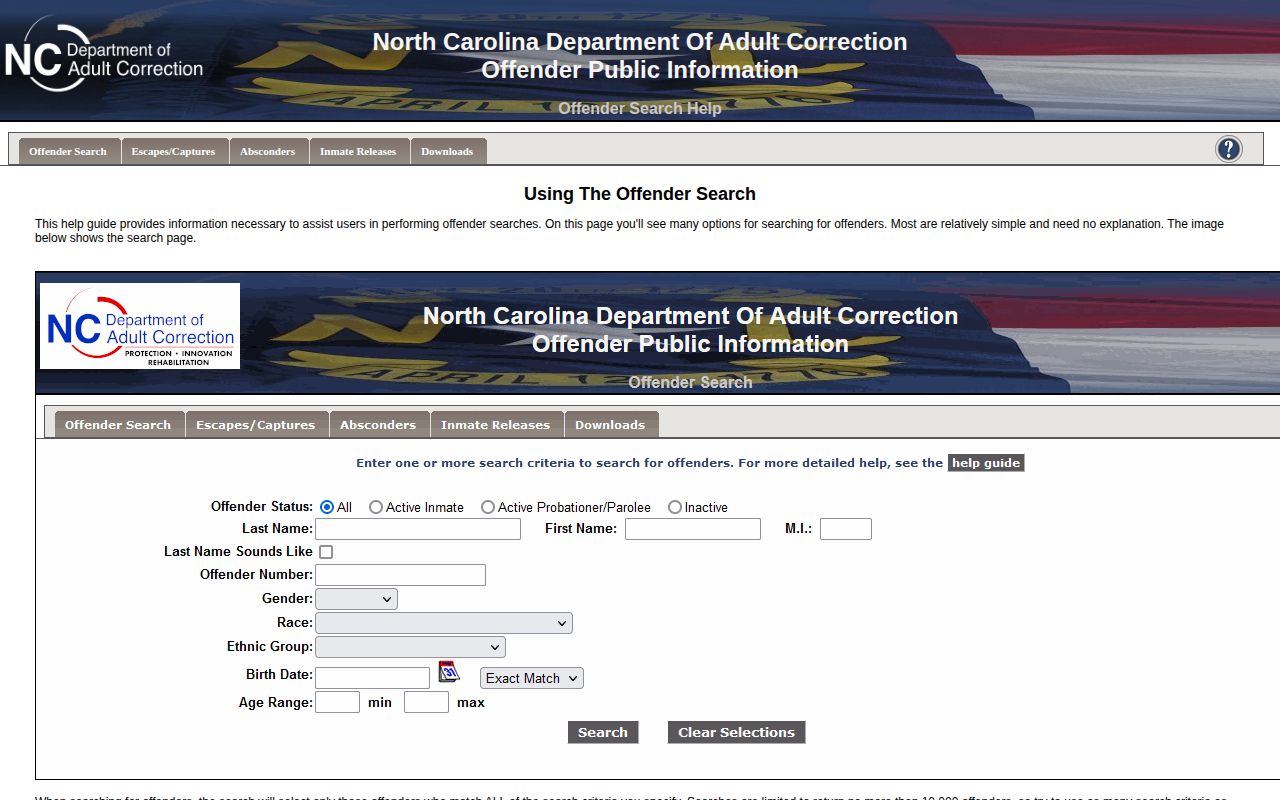
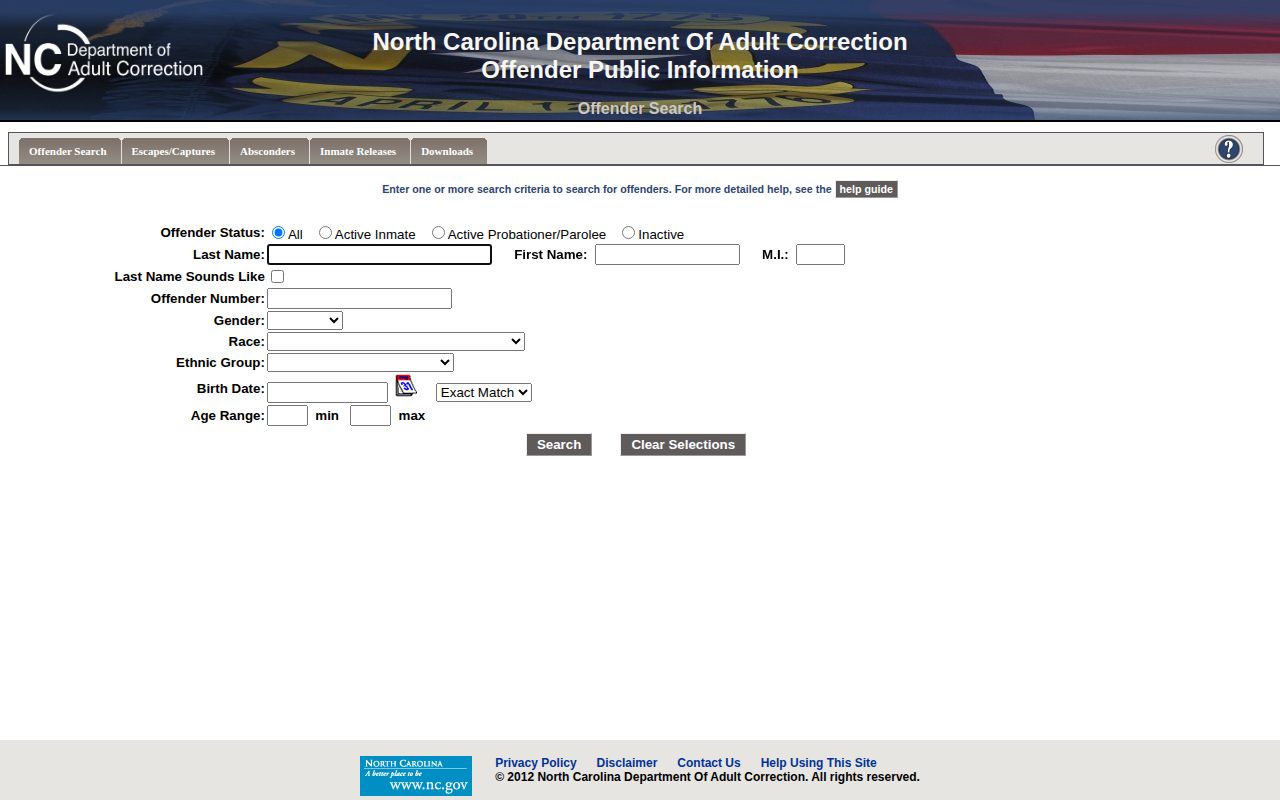
The NCDAC offender search demonstrates the state search and an active record with projected information.
| State record item | What it can establish |
|---|---|
| Offender number | The strongest public identifier for matching an NCDAC record. |
| Current status | Whether the record is active in prison, active in supervision, or inactive. |
| Admission and sentence history | The term and custody episode tied to the calculation. |
| Projected information | The current forecast for an active sentence when displayed. |
| Actual release or discharge | A past state custody event, subject to later admissions. |
| Supervision information | Whether physical release is followed by community supervision. |
Carteret Structured Sentencing Rules
North Carolina Structured Sentencing applies to crimes committed on or after October 1, 1994. Ordinary discretionary parole was removed for those modern terms. NCDAC explains the framework as service of at least 100 percent of the minimum and 85 percent of the maximum, followed by post-release supervision for eligible felony sentences. The Commission sets supervision conditions in those cases; it does not choose the ordinary statutory release point.
The “85 percent” phrase is often misread. It does not mean every Carteret County prisoner can subtract 15 percent from a pronounced sentence. G.S. 15A-1340.13(d) requires service of the felony minimum. Earned time can reduce the maximum, but not below that minimum. The judgment's minimum and maximum, offense date, offense-specific law, concurrent or consecutive terms, prior confinement credit, and post-release-supervision rules all affect the true computation.
- Minimum term
- The floor that must be served under the applicable structured felony judgment.
- Maximum term
- The outer term that credits may reduce within statutory limits.
- Post-release supervision
- Community supervision that begins after eligible physical prison release.
- Max out
- NCDAC's term for sentence expiration in the applicable context.
Carteret Release Credits Differ
Sentence credits depend on both the kind of sentence and the custodian. Qualifying pretrial confinement credit is governed by G.S. 15-196.1 and related law. NCDAC earned-time rules operate under G.S. 148-13 and department policy. Meritorious-time changes can alter an NCDAC projected release date, but a general policy cannot be used to predict one person's final release without the current calculation.
Local sentenced confinement has its own limits. For an active misdemeanor sentence, G.S. 15A-1340.20(d) authorizes earned time and caps the combined award at four days per month. G.S. 162-60 provides local-confinement earned-time authority, while G.S. 148-13 directs NCDAC rules to local jail administrators for sentenced jail prisoners. Ask Carteret for the actual sheet only when a local sentence exists.
Note: A pretrial detainee earns no sentence-based PRD because no local or state sentence has yet supplied the calculation.
Carteret Release Dates Can Change
A projected date is recalculated when one of its lawful inputs changes. Some changes move the forecast earlier, while others delay release or change its destination. A detainer, warrant, or pending charge can also turn an apparent release into a handoff to another custodian. The table separates the main factors documented for North Carolina terms.
| Factor | Possible effect | Best confirming source |
|---|---|---|
| Earned or meritorious credit | May reduce the maximum within governing limits. | NCDAC or Carteret sentence calculation |
| Disciplinary credit change | Can revise a previously displayed projection. | NCDAC current calculation |
| Confinement credit | Qualifying time already held may count toward the term. | Judgment and calculation sheet |
| Concurrent or consecutive terms | Changes how two or more sentences combine. | Court judgment and NCDAC Combined Records |
| Later court order | May change the sentence or authorize release. | Carteret court file |
| Detainer, warrant, or hold | May cause transfer instead of community release. | Releasing and receiving agencies |
| PRS or eligible parole | Changes the legal status after physical release. | NCDAC and the Commission |
For older or specially eligible sentences, parole law may still matter. Modern Structured Sentencing terms generally reach statutory post-release supervision rather than a discretionary parole date. Read the offense date and sentence type before attributing a change to parole. Where a court order and a public portal differ, the custodian's audited calculation and the filed order deserve priority.
Carteret State Release Weekday Rules
NCDAC release policy draws a careful line between ordinary business-day processing and mandatory statutory release. Ordinary prison releases generally occur Monday through Friday during business-release operations. When a projected date falls on a weekend or holiday, discretionary credits may allow some max-out cases to process on the prior weekday. That rule does not create a universal early release.
Mandatory post-release-supervision and parole releases occur on the statutory date even when it falls on a weekend or holiday. This is the distinctive North Carolina state-prison rule. It applies to NCDAC releases, including a qualifying Carteret Correctional Center term. It is not a promise about the hour or day when Carteret County Detention Center processes a local jail release. No official Carteret source supplied a standard jail release desk time.
The state offender-release procedures support the weekday and statutory-date distinction.
Note: Weekend treatment depends on the legal release category, so the displayed PRD alone cannot establish the processing day.
Confirm Carteret Actual Release
After the projected day arrives, check the responsible system again. For a state prisoner, read NCDAC current status and the full sentence chronology. The dedicated Inmate Release Search can help with past state releases, but “release county” does not mean the person was booked in Carteret County jail. If public fields are missing, NCDAC's public-record request route can seek a specific release date tied to the offender number and sentence.
For a local sentenced person, ask Carteret County Detention Center whether release was completed and whether any transfer or hold followed. The court file explains the judgment and later orders, while the jail entry records physical processing. A Carteret County VINELink alert can notify of a supported event, but a source-agency lag remains possible. Match two records when timing is disputed. A forecast becomes an actual release only after the custodian records what occurred.
Use exact identifiers in any follow-up. For NCDAC, give the offender number, facility, term, and date range. For the Carteret jail, give the booked name, booking or inmate number when known, and the local sentence at issue. Ask for the projected calculation separately from the completed release entry. That wording helps the agency answer whether the date is still a forecast, whether staff have processed an exit, and whether another agency received the person. It also avoids blending a past state release with a later Carteret County custody episode.
The NCDAC field and status help explains how active inmate, active probationer or parolee, and inactive records differ.